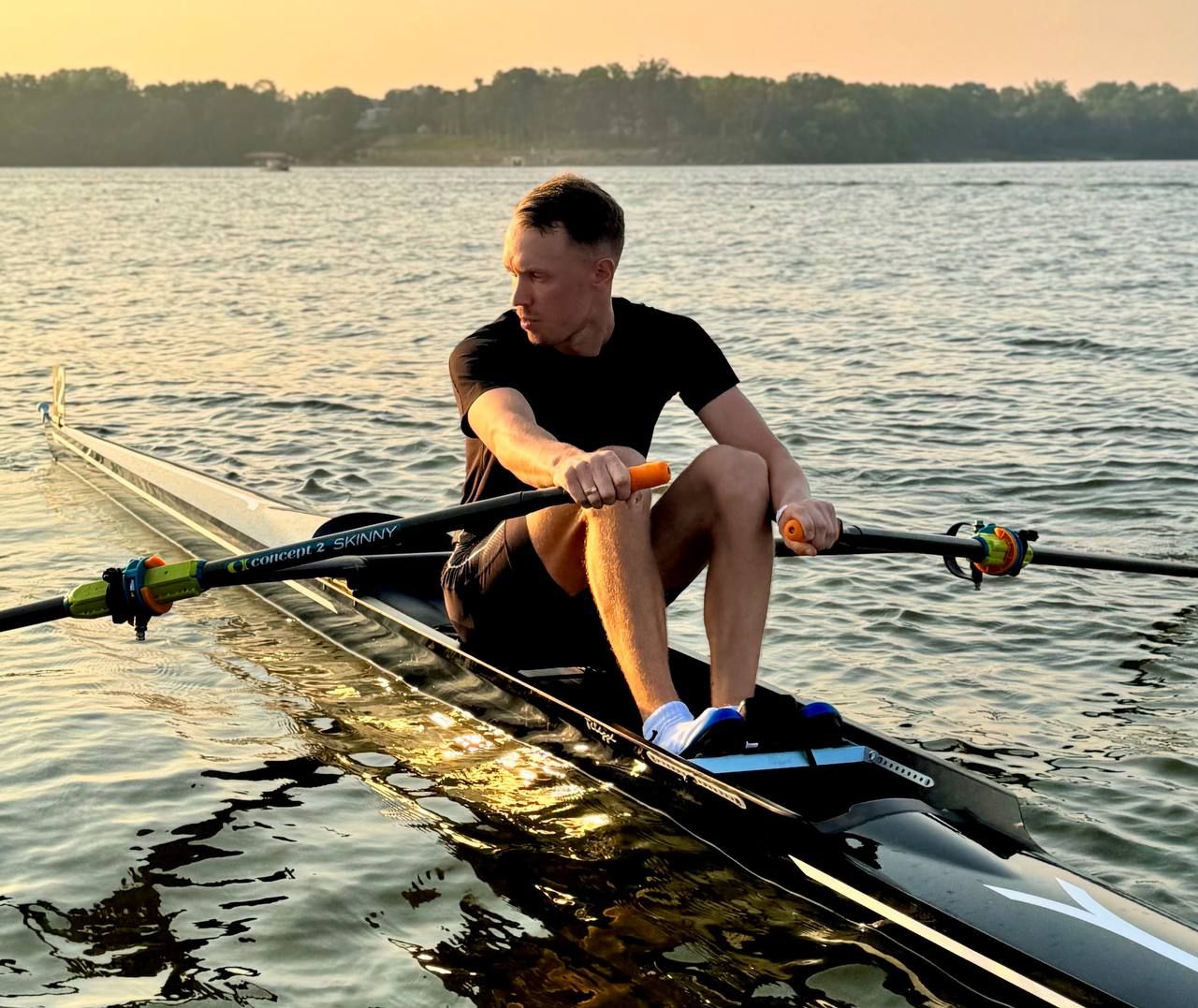
Rowing is one of the world’s oldest organized sports. Historical records show that competitive rowing existed as early as 1430 BCE (almost 3.500 years ago), with Egyptian inscriptions depicting rowing contests on the Nile. Over the years, the sport has evolved from wooden boats into a highly technical discipline built on carbon-fiber shells, biomechanical sensors, precision oar angles, and Olympic-level training science. However, one thing hasn’t changed: rowing demands everything from the human body.
Rowers live at the intersection of strength, cardiovascular power, and mental resilience. A single race demands explosive force, flawless coordination, and the ability to hold discomfort longer than feels humanly possible. Yet despite this, rowing is often underestimated by people who think of it as “just cardio.” Athlete Vladyslav Avramenko knows how far the sport can take you. A multi-time champion and prize-winner of Ukrainian national competitions and now an active competitor in major U.S. regattas, he also gained recognition in Ukraine as a technical judge, evaluating athletes’ technique, rule compliance, and race execution, experience that sharpened his understanding of what truly drives performance. His approach shows that you don’t have to be a professional rower to benefit from elite principles. Anyone who cares about fitness can borrow the lessons.
This article breaks down the core ideas behind his system and translates them into strategies you can use in your everyday training, whether you’re a gym-goer, a runner, or a weekend cyclist.
Discipline Is a Trainable Skill
Discipline is often seen as a trait a person either has or doesn’t. In reality, high-performance rowing shows that discipline works more like a muscle, growing through routine, structure, and repetition. Progress comes from steady habits, not bursts of motivation.
Vladyslav trains discipline the same way he trains endurance — through structure. His sessions are planned in advance, his weeks follow a clear rhythm, and every workout has a defined purpose. This routine was shaped during his years in the Ukrainian national team system and the Sports School of High Sportsmanship, where staying focused under pressure mattered as much as physical preparation. Over time, he learned to treat discipline as a psychological skill: staying calm when sessions pile up, keeping momentum through low-motivation days, and returning to routine quickly after disruptions. This combination of structure and mental steadiness helped him win national titles, and it remains the foundation of his training today.
“People think discipline means being constantly motivated, but it doesn’t,” Vladyslav says. “Even I sometimes want to give up or skip a session. Everyone does. What helps is routine. Small sessions are still sessions. Consistent effort beats perfect effort every time. When the habits are simple and steady, it’s much easier to come back after a tough day or a setback.”
Train Smarter with Data
One of the biggest mistakes recreational athletes make is relying on “feel.”
“A lot of people go for a run and just guess their pace. They get on the rowing machine and guess their power. They lift weights and guess how hard they’re really working,” Vladyslav says. “But you can’t improve what you can’t measure. The moment you start looking at simple metrics like watts, heart rate, split times, even a short video of your technique, your training stops being random effort and starts making sense.”
Vladyslav’s training system, shaped by years of elite preparation and technical analysis, is built on data. His approach includes power analysis, split times, GPS speed, technique metrics, heart-rate zones, step tests, and video reviews. This analytical method has noticeably improved both his own performance and the performance of athletes who come to him for help. Stability on long distances increases, force distribution in sprints improves, technical errors are reduced, and overall boat speed is raised through more precise, individualized training adjustments
However, you can use the same tools, even if you’re not a professional. Here’s what the expert recommends. Power is the base. Watts give a more honest picture of effort than calories or time. They show the real output and make progress easier to track. Heart-rate zones are the next piece. Many recreational athletes push too hard on light days and not hard enough on heavy ones. Zones help keep intensity under control and prevent burnout.
For outdoor workouts, even simple GPS pacing makes a difference. It removes the “I think I went faster” guessing and shows how steady the pace actually was.
Every few weeks, Vlad suggests adding a small step test. Warm up, raise the effort in short increments, watch how the heart rate or wattage responds, and notice the moment technique starts to break. This becomes a personal reference point and shows how fitness changes over time.
And finally — video. A quick recording often reveals things that are impossible to feel in real time: posture, timing, alignment. Vlad uses video analysis constantly, both for himself and for others, because those small details add up.
Personalization Beats Any Cookie-Cutter Program
One of the things Vladyslav sees most often in recreational training is imitation. People copy someone else’s workout plan, a friend’s routine, a pro athlete’s session, or something pulled from social media, and expect it to work the same way for them. In rowing, this rarely happens. And the same is true for most sports.
Vlad’s own approach is built around customization. He looks at how an athlete applies power, how long they can hold a certain frequency, how their technique changes under fatigue, and what kind of distances they are preparing for. Physiological thresholds, stroke mechanics, and race formats all influence how the training plan should look.
“Two athletes can follow the same session: one gets stronger, the other burns out. Generic programs fail because they don’t match the person using them. Training only starts to work when it’s built around the individual,” the athlete says.
Vlad’s experience shows that progress comes much faster when the training fits the body, not the other way around. In his own work, this approach has led to real improvements: athletes who follow his individualized adjustments see more stable performance on long distances, better force distribution in sprints, fewer technical errors, and higher boat speed thanks to more precise, personalized training setups
These lessons form the core of Vladyslav Avramenko’s approach, but they are not the whole picture. His system also includes deeper analytical tools: examining how power is distributed across different types of effort, using stepwise testing to track physiological changes, working with heart-rate zones to avoid overtraining, and understanding how various intensity formats place different demands on the body. Together, these elements show that successful training in any discipline is rarely built on one principle alone. It’s a combination of smart, connected practices, many of which can be adapted by anyone who wants to train with more intention, more structure, and more clarity.